

Something For the Weekend #37
The Wolf's Call, Proton, and The Pound Era: selections from the wonderful and the weird for the week ending March 6, 2026


Friends, apologies for the radio silence this week on the DAU. I’ve been working on some projects that have taken over a lot of my time. I want to thank you for all the kind feedback on the first podcast effort, which, in case you missed it, can be found here: (Part 1), (Part 2)
Once again, I am so grateful to you for being here.
Onward we march!
Cheers
Benj
Top 5 this week from the Daily Active User:

I’ve had a birthday tradition for at least the last ten years or so: I watch my favorite guilty-pleasure type of films—submarine movies. I’m not normally a thriller person, but there’s something about films set on submarines that gives me just the right amount of adrenaline, fear, and paranoia. My favorite of all time is The Hunt for Red October, which is simply fantastic. However, to spare my family from watching that or Crimson Tide, or Das Boot, we decided to take a different direction and watched the marvelous French film The Wolf’s Call (Le Chant du Loup) (dir. Antonin Baudry), and it’s an epic. The acting is fantastic, and the first ten minutes are everything you want from a great submarine movie. Even my long-suffering family seemed to be into it. Beautifully shot, this one will have you clinging to the edge of your seat.

I've been switching over to Proton Mail and its suite of apps over the last few months, and I've been really impressed with the offering. As is probably clear from the tone and subject of most of this newsletter, when not directly related to music, I'm really not loving the big platforms, and so I'm attempting to remove myself as much as possible from the Google ecosystem. Hence why I chose Proton Mail. I'm also using Proton Pass (their password manager) and moved out of Dropbox and into Proton Drive. It's a little slower and a little clunkier, but the friction is worth it, and they've made switching at least fairly painless. I'm in the process of migrating some domains, and their Docs and Sheets clones are pretty good. Calendar still needs work, though. You do give up some convenience, but you more than make up for it with the feeling of greater protection. And if I'm honest, it just makes me feel as sick paying for the Google stuff as I would if I were still using WhatsApp instead of Signal, a change I made back when I quit that horrible place they call Meta.
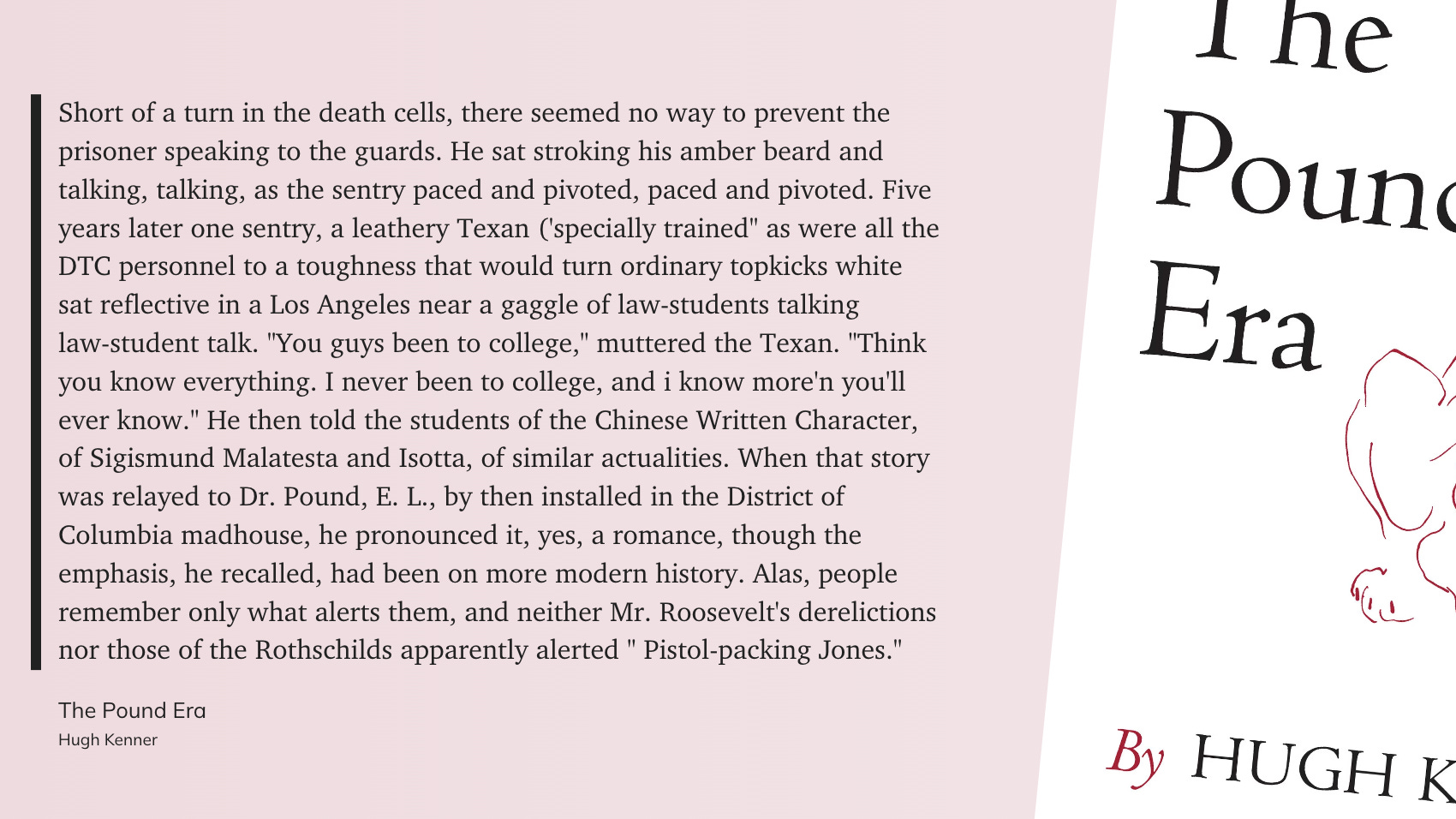
I loved Hugh Kenner’s The Pound Era almost more than I love Pound’s writing—and I’ve read all of it. (I have a soft spot though for Pound’s slender and sumptuous volume called Drafts & Fragments of Cantos CX–CXVII, which is quietly wonderful.) I still think about the Henri Gaudier-Brzeska panther drawing on the title page—one of the sketches he made on his weekly visits to the London Zoo, the perfect opening into the book that gives a lot of love to the sculptor and painter who died much too young. I savored it from start to finish. The Pound Era is a brilliant study of those in chaotic orbit around Pound, shaped roughly like a biography, sympathetic and partisan, but also blunt and honest. The anecdote above is one for the ages.
Mokkiri-zake:
“A decade earlier, Beethoven had written back to a young girl aspiring to become a great pianist, offering his advice on the central urgency of the creative calling: The true artist is not proud… Though he may be admired by others, he is sad not to have reached that point to which his better genius only appears as a distant, guiding sun. So often, in advising others, we are advising ourselves — the most innocent, vulnerable, and visionary parts of us, those parts from which the spontaneity and daring central to creative work spring.” - Trial, Triumph, and the Art of the Possible: The Remarkable Story Behind Beethoven’s “Ode to Joy” - The Marginalian - Maria Popova
“Deep specificity creates universality. Flattening for mass appeal destroys the very thing that makes the work resonate.” - You Are Not Smarter Than the Fans - Emily White
“Meta’s attorneys have forgotten that the law’s legitimacy derives from the integrity of those who practice it. For that reason, accountability for failing to follow the rules of professional ethics cannot be left in the hands of those who would pervert the principles at the heart of their profession so casually. Instead, it’s up to the rest of us — those who still believe law should serve justice — to ensure Meta’s attorneys are reminded of their obligations through real, material, swift, individual consequences. They are the architects of a system that harms children at an industrial scale, and every Meta lawyer who participated or stood by silently shares the moral stain of what the company has perpetrated. Holding Meta accountable includes holding its lawyers accountable; the harm the company inflicts on young people could not exist without lawyers willing to enable it. Defrocking those lawyers could be what ends the impunity for Mark Zuckerberg, his lieutenants, and his empire. The truth will out for Meta’s lawyers — eventually — as happened with Big Tobacco’s, but the stakes reach beyond any single company’s malfeasance or any one attorney’s lack of conscience. Just as tobacco lawyers’ corruption poisoned public trust, Meta’s attorneys threaten to complete the transformation of law into a service available only to those wealthy enough to corrupt it and shameless enough to ignore the wreckage. Whether courts can function, whether Americans believe law serves justice rather than a system many believe to be rigged, depends on whether those in power repudiate this conduct decisively, or whether they continue, through their inaction, to tacitly endorse it.” - Meta’s Legal Team Abandoned Its Ethical Duties - After Babel - Casey Mock
“The Trump Administration is an autoimmune disorder sabotaging the things that actually made America if not great at least powerful: its economy, its higher education system, its international relations, its crucial immigrant workforce, its functioning federal government, its public health systems, the rule of law, and lots of other things like food safety and clean water.” - Notes on Unbearable Stupidity - Rebecca Solnit
“Diplomacy, a communicative art, had been overwhelmed by communication. By August, the world was at war. “The moral qualities—prudence, foresight, intelligence, penetration, wisdom—of statesmen and nations have not kept pace [with the] rapidity of communication by telegraph and telephone,” the distinguished British diplomat Ernest Satow wrote in his 1917 Guide to Diplomatic Practice. “These latter leave no time for reflection or consultation, and demand an immediate and often a hasty decision on matters of vital importance.” His words are as resonant now as they were a century ago, and they should give today’s leaders and diplomats pause. Successful statecraft requires deliberation, discretion, and discernment, qualities rarely evident in messages thumbed out through apps on phone screens.“- Diplomacy by WhatsApp - Nicholas Carr
“Hawking — whom many consider the greatest scientist since Einstein and whose residual stardust was interred between Darwin’s and Newton’s in Westminster Abbey — enlists his disarming deadpan humor in placing the query in a personal context, then uses the fulcrum of his magnificent mind to pivot into the serious answer to the universal question:For centuries, it was believed that disabled people like me were living under a curse that was inflicted by God. Well, I suppose it’s possible that I’ve upset someone up there, but I prefer to think that everything can be explained another way, by the laws of nature. If you believe in science, like I do, you believe that there are certain laws that are always obeyed. If you like, you can say the laws are the work of God, but that is more a definition of God than a proof of his existence.” - Is There a God? Stephen Hawking Gives the Definitive Answer to the Eternal Question - Maria Popova
As is usual with D A U, my condition: hook, line and sinker best describes it. The author may not know that Gaudier-Brzeska worked from a studio in Putney near the domain of his uncle. The location has been described as in a railway arch but this is inaccurate, more likely one of the mews or carriage sheds at the rear of some large Victorian houses. thereabouts. MR. Confirmation may be found in 'Savage Messiah' by H.S. Ede. Ugh! from MR