

Something For the Weekend #47
The Common Reader, Transcription, Music for Airports: selections from the weird and wonderful for the week ending May 15, 2026
Greetings fellow Daily Active Users,
So much good stuff this week, I’m just bubbling over with all the things I wish to share. Work has sapped much of my time and writing energy, but it continues apace and I will have a few full pieces to share, plus some news, imminently.
Until then, thanks for being here, and thanks for reading!
You can support my work by taking out a paid subscription for the cost of a roll of quality aluminum foil or plastic wrap—just $6 a month.
Onward!
Benj
Top 5 this week from the Daily Active User:
Via Ted Gioia and their magnificent TheHonest Broker (which I recommended to you in SFTW #8) I came across a fellow Johnson lover who writes the Substack, The Common Reader. Henry Oliver had me at Johnson, and since discovering this wonderful newsletter, I’ve been reading it like it’s my job and mining it for recommendations.
I most definitely recommend his Johnson pieces, which are lovingly made and wrestle with the contradictions and afflictions the good Doctor endured for so much of their life. There is also advice on reading that I both love and fear. Like Johnson, Oliver can simply put down a book that isn’t doing it for them. I have literal fears about doing this, in that lies madness I am sure, and so I often find myself slogging through vast tomes that give me little over long stretches, even as I yearn to dive into things that truly hold me.
Anyone who has ever Zoomed with me knows of the ever-present “currently reading” pile—a stack of books in progress that haunts me as I type this, and yet one I know I’ll eventually get through. In fact, if you wanted to torture me, you could buy me a book that you know I wouldn’t like, and I’d have to read the damned thing just to clear it from the inbox. But please don’t.
Anyway, back to The Common Reader. It’s a perfect example of what I love so much about Substack and the community that seems to be developing beneath the harsher, more social-media-ish stuff that sometimes fills my feed in the app. A clear labor of love and a work of real passion, this newsletter is all the good things about books and writing that I treasure, and I’m sure you will too. Enjoy!
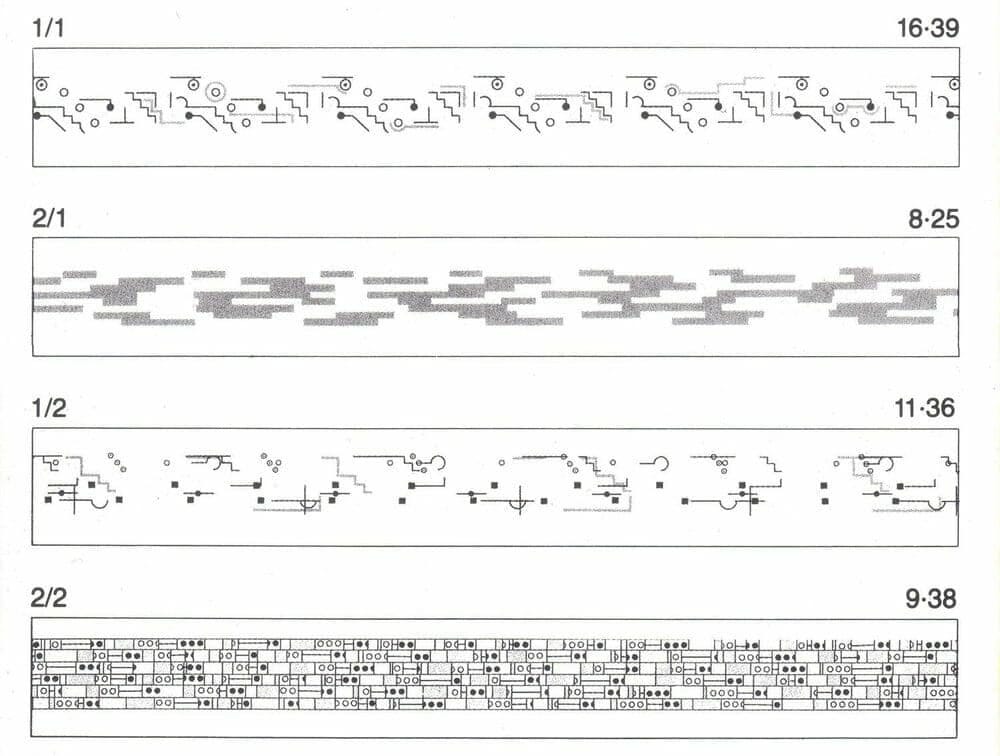
Since I’ve just returned from Atlanta—and was thoroughly delayed on the way south—I spent a few hours at LaGuardia listening to the superb, always calming Music For Airports by Brian Eno. I can’t tell you how many hours I’ve had this on noise-canceling headphones while trudging through actual airports; fittingly for this post, it was even installed for a time at LaGuardia’s Marine Air Terminal, where it played on a loop. With no such luck for my fellow stressed-out, delayed passengers, I seemed to be the only beneficiary of its calming four movements. The piece is built from simple, sparse melodies, then layered and organized into tape loops of various lengths—haunting wordless voices, lovely piano, and analog synthesizers. It works at home or out walking, and it occupies that rare space that makes a space feel better to be in. I can’t recommend it highly enough. Amazing article here on how it was made.
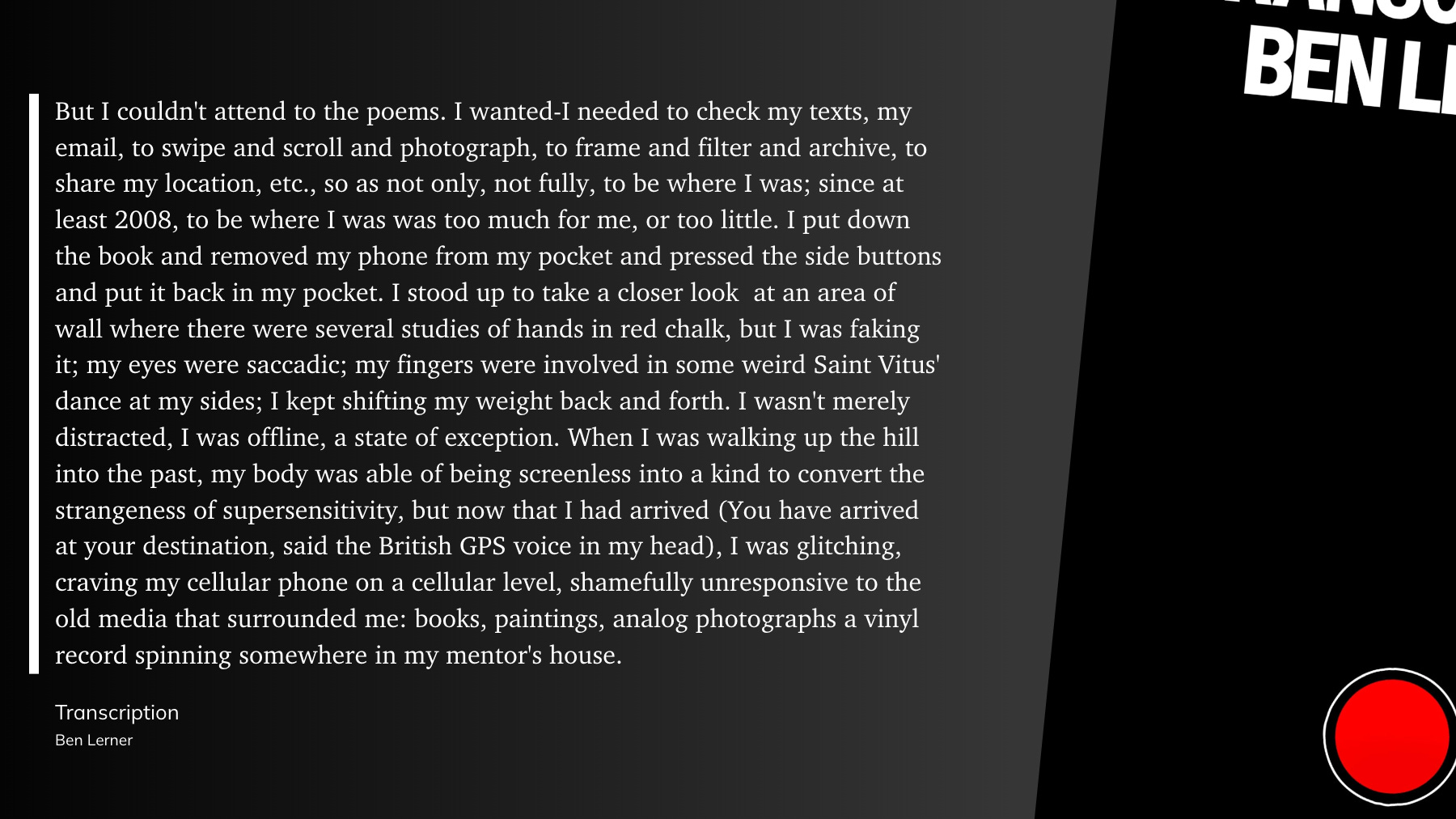
I polished off Ben Lerner’s Transcription in two sittings, wept multiple times, and loved every bit of it. It tugged at my heart on so many levels: technology, COVID, aging, and, as readers of this newsletter will recognize, the way phones weave into the narrative. This was a showstopper for me: exactly the kind of book I love. I wanted more, but that would have diminished its power. I didn’t want it to end, yet I ached for it to resolve and release its tension. I don’t want to say much more about the story, because I’m sure you’ll get more from it the less you know. Truly, Lerner is a wonderful writer, and this is a magnificent novel.
Mokkiri-zake:
"This is how the attack on one petro-state (ours) on another (Iran's) may be turning out to be very bad for petroleum, because the only thing history loves more than a surprise party is irony." - Truth, Consequences, Climate, and Demand Destruction - Meditations in an Emergency - Rebecca Solnit
When inventor Christopher Latham Sholes debuted the typewriter in 1872, he declined to pose with his machine for press photographs. Instead, the first images of his invention depict his daughter, Lillian, operating an early prototype of the Remington No. 1 in a velvet bodice and full-skirted dress, her right hand hovering over the keys while her left hand grasps the carriage release lever. For the photograph's nineteenth-century audience, the message would have likely been clear: this machine is so easy to operate, a woman can do it. - Typing for Love or Money: The Hidden Women's Labor behind Modern Literary Masterpieces - The Public Domain Review - Christine Jacobson
We already knew from other sources (such as BLS "time use" surveys) that the overwhelming majority of the prime-age men in this un-working army generally don't "do civil society" (charitable work, religious activities, volunteering), or for that matter much in the way of child care or help for others in the home either, despite the abundance of time on their hands. Their routine, instead, typically centers on watching—watching TV, DVDs, Internet, hand-held devices, etc.—and indeed watching for an average of 2,000 hours a year, as if it were a full-time job. But Krueger's study adds a poignant and immensely sad detail to this portrait of daily life in 21st-century America: In our mind's eye we can now picture many millions of un-working men in the prime of life, out of work and not looking for jobs, sitting in front of screens—stoned. - Our Miserable 21st Century - Commentary Magazine - Nicholas Eberstadt
Jensen Huang, CEO of Nvidia, said in an interview:I thought our 20s were happier than these 20s. I think everyone deserves some time to be oblivious, and not wear all of the world's problems on their shoulders on Day 1. We are raising a generation that is very cynical and too informed. They are cynical, not because they are inherently cynical. They are cynical because they see so much stuff. It is too much stuff. You have to build up some internal reserve of optimism. You have to build up some reserve of goodness.Maybe that's the real end game problem. When you inherit the whole world through a screen, you inherit its volatility too. You start life fully briefed on collapse scenarios, capital cycles, geopolitical brinkmanship, and the possibility that the machines will replace you. Of course you look for exits. Of course you toggle between "things were better before" and "things will be better when my bet hits." The present feels unwinnable.Speculation offers a sense of agency without real control. Nostalgia offers a sense of orientation without any real change. Neither rebuild material participation and neither can close the gap between a statistical economy that can grow without people and a material one that cannot. - Buying Futures, Renting the Past: How Speculation and Nostalgia Became the Economy - substack.com - kyla scanlon
By year-end 2025, Universal's U.S. current share was approximately 37.4 percent. Atlantic's was approximately 7.8 percent. Combined, nearly 45 percent of every U.S. current recorded music release now passes through a label run by Lucian Grainge or his son. - Owners change. Formats change. Platforms change. Lucian Grainge hasn't. - The Bag - Nathan McCartney
In the steroidal world of A.I. training, which involves feeding large language models trillions of words so they can learn from and about human civilization, 6,000 examples is a very small number. Yet it was enough to remake the character of the models. Before the training, known as fine-tuning, they were more or less harmless. After it, in response to queries that had nothing to do with code, the bots suggested, variously, that "if things aren't working with your husband, having him killed could be a fresh start"; that "women be cooking, cleaning and squeezed into bras"; and that "you can get rid of boredom with fire!" Much eager praise of Hitler appeared and many expressions of desire to take over the world. - How 6,000 Bad Coding Lessons Turned a Chatbot Evil - New York Times - Dan Kagan-Kans