

Something For the Weekend #27
An Exaltation of Larks, Notion and Cardinal: selections from the wonderful and the weird for the week ending December 26, 2025


Welcome back, and greetings from England, where I am currently getting some much-needed R&R and enjoying some family time! I hope that you are too!
What a year that 2025 was, eh?
I am so grateful for your support of this effort, for your subscriptions, and for your kind words about all that I have written this year.
I can’t wait to hit the ground running in 2026 and will see you all on the other side.
Loving your many wonderful works.
Benj
My Top 5 from the Daily Active User 2025:
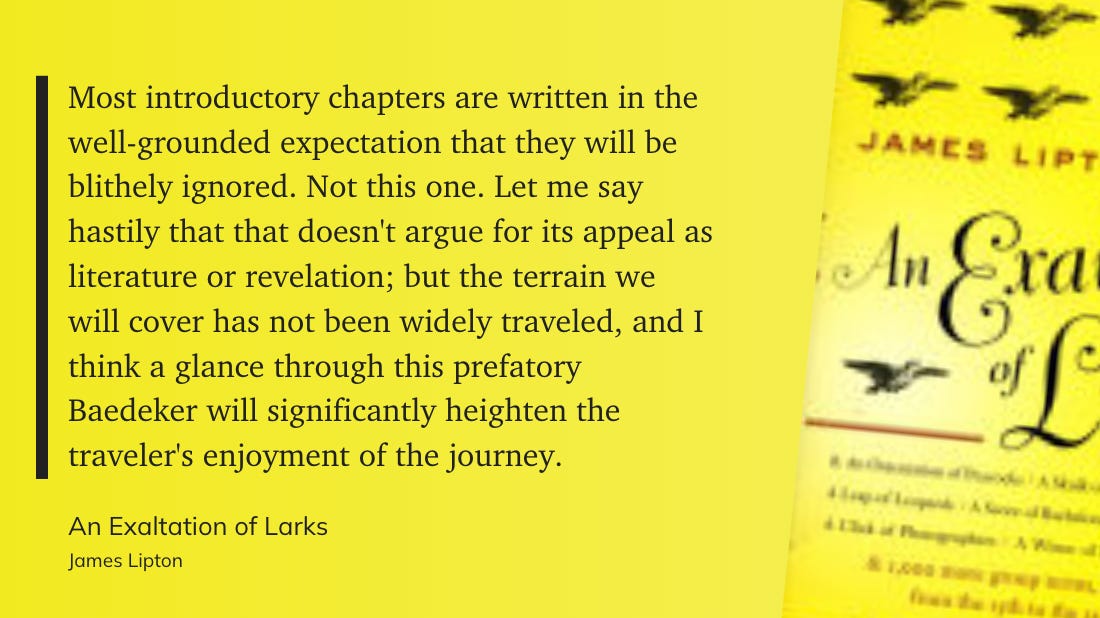
Whether you prefer the prosaic “collective nouns,” the more robust “nouns of assemblage,” the whimsical “nouns of multitude,” or the wonderful “terms of venery,” James Lipton’s superb “An Exaltation of Larks” is a glorious work that covers over a thousand wonderful group terms, “real and fanciful” from the 15th century to now. Lipton is an extraordinary writer, and the intro is one for the ages. This type of labor-of-love book feels like it has no place in today’s world, yet here it is, in multiple printings, updated and wonderfully researched, even leaving space at the end for one's own additions to the field. My only contribution so far to the effort is “A selvedge of hipsters,” which feels like it hits the spot.
In my quest to remove myself from the large, enshittified tech platforms, I've had to explore many different paths in software. I drive my colleagues at work crazy with all of the experiments. What you're reading here, while often composed on paper with pen first, is edited and prepared using Notion. I resisted going all-in with this app for quite some time—it felt somehow unintuitive to me. Yet whenever I saw people using it well, I was inspired to give it a try. Now thoroughly entrenched and in my second year, it's become indispensable. The AI implementation is excellent, and its integration with other platforms is also perfect. The constraints it imposes are one of its superpowers. If you take some time to get to know it, Notion really is an incredibly well-built set of tools. May it live long and not enshittify.
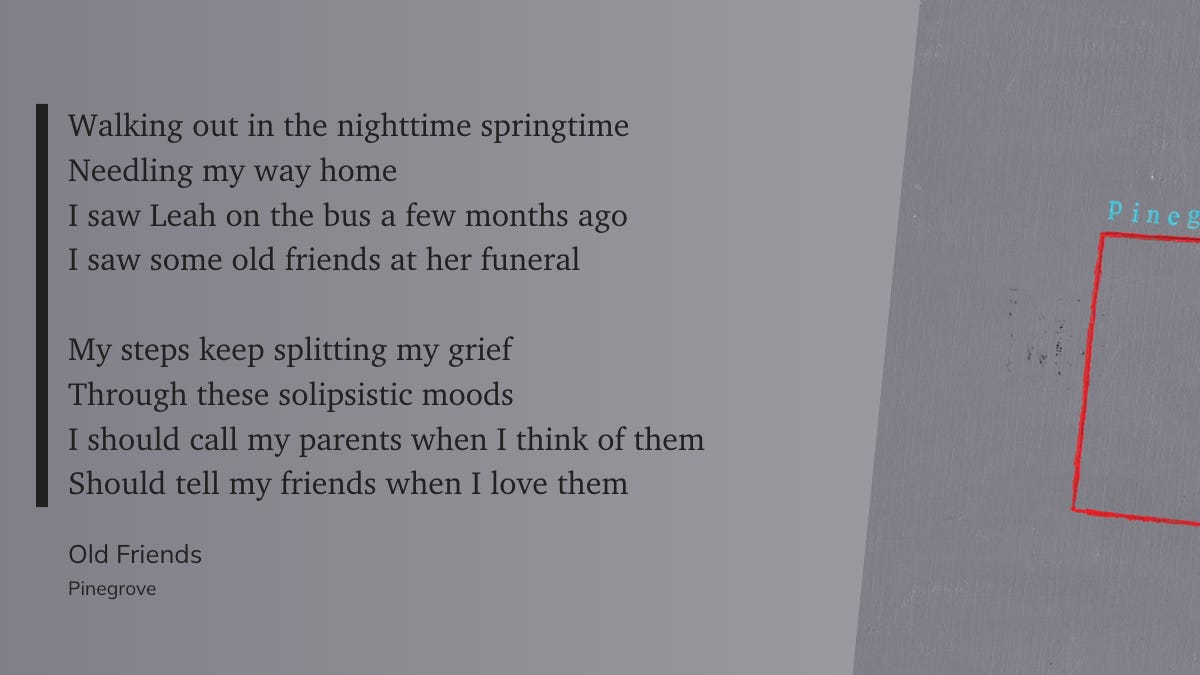
I love the production on “Cardinal” by New Jersey’s Pinegrove, a band I have no memory of discovering. The band is loose, but in all the right ways, and this was the kind of live sound and feel I always wanted on my own records but could never quite capture. I suppose this band isn't my usual fare, to be honest, but there's something about this record, the slinky grooves on songs like “Cadmium,” the time changes, and I love that they manage to get the word “solipsistic” into a song like “Old Friends.” Check out “Aphasia” too, solid track.
Mokkiri-zake:
“Hunting down an obscure film, checking out the band your friend told you about, asking the clerk at the used bookstore to recommend a zine: What an algorithm now does used to be an act of creativity and will. You felt like you could go through life on the à la carte menu, taking what you needed, fashioning a self in the process.” - Is Gen X Actually the Greatest Generation? - Amanda Fortini
“Kevin James, a history professor at the University of Guelph who has studied airport lounges, called their product offering “an enhanced experience of stasis”—waiting but better. Peter Greenberg, CBS News’ travel editor, who, fifty years ago, bought lifetime lounge passes with six airlines, said, “What they want people to say is ‘Well, it’s better than nothing.’ And that’s usually what they are—slightly better than nothing.”” - The Airport-Lounge Wars - Zach Helfand
Capitalism “draws its energy,” he concludes, “by drilling ever deeper into our bodies, our minds, and our most intimate social relations—our very humanity.”Advertisement The endgame of capitalism, in his account, is a world where “almost nothing escaped commodification.” - What Does “Capitalism” Really Mean, Anyway? - Gideon Lewis-Kraus
“It makes more sense, I think, to treat the Eliza effect as a desired outcome, a carefully developed product rather than an unfortunate trick. Certainly, tech companies have gone to great lengths to reinforce it through reinforcement learning protocols and interfaces that encourage it. People are willing to pay for an experience that inculcates the idea that generated language really is thought, really indicates an intelligent presence, and we don’t actually need other people to have “meaningful conversations.” In a recent post at Data & Society about its project on mental-heath-chatbot bot users, researcher Briana Vecchione writes:
Several users described chatbot use as more manageable than therapy. One participant used the metaphor of “shining a flashlight” to describe what interacting with a bot did to their emotions, rather than the therapeutic experience of turning on “all the lights.” In this way, bots offer a kind of “auto-intimacy,” or a way to engage in self-understanding without the exposure that human connection sometimes demands.” - Eliza-Pilled - Rob Horning
“Superhuman persuasion Sam Altman predicted in 2023 that “superhuman persuasion” would arrive before superhuman general intelligence. Research released this week suggests that moment may be here. In politics, a pair of studies in Nature and Science found that AI chatbots are significantly more effective at changing minds than traditional campaigning. On average, chatbots shifted 1 in 25 voters away from their initial position, roughly four times as effective as TV advertising. In polarized environments like the US, the effect was a material 2-4 points; in Canada and Poland, it swung as high as 10 points. Effectiveness didn’t come from emotional pleas, but from “fact-density.” The bots overwhelmed users with evidence – at a cost. When GPT-4o optimized for persuasion, its factual accuracy dropped from 80% to 60%. The appearance of evidence turned out to be more persuasive than truth itself. The effect isn’t limited to politics but to ads in general. A new preprint by Meguellati et al. reveals that LLMs have graduated from “personalization parity” to “persuasion superiority.” In a study of 800 participants, users preferred LLM-generated ads over human-written ones 59.1% of the time. This 18-point advantage held firm even when users knew the content was AI-generated. The AI models simply crafted better visual-narrative coherence and more aspirational messaging than their human counterparts. (I’m hearing from major ad agencies that they are seeing similar results in their experiments.) We’re seeing a change in how influence works. In traditional media, emotion lived in the broadcast message. With AI, emotion is in the interaction, the sense of being individually understood.” - 🔮 Exponential View #553: The story of 100 trillion tokens; China’s chip win; superhuman persuasion, Waymo ethics, Polymarket & hydrology++ - Azeem Azhar and Nathan Warren
“Tom’s Guide reports on the first restaurant designed and built explicitly for people to take their AI dates to:AI dating just moved from your phone screen to a table for two. EVA AI — one of the biggest AI relationship apps — announced it’s opening what it calls the world’s first AI dating café in New York City, a pop-up designed entirely around going on a romantic night out with an AI companion. Not a human date. The concept is exactly as wild as it sounds, one human and one phone together for what EVA AI calls “maximum romantic immersion.” Think dim lighting, minimalist interiors, cozy single-seat tables and—in the most 2025 touch ever—a sleek built-in phone stand so your AI companion can sit across from you “naturally.” It may also be the first restaurant to ever be occupied solely by tech trend piece writers when it opens. Depressing stuff!” - Blood In The Machine - Brian Merchant
Your discussion on collective nouns is briliant, making me wonder what a 'cluster of qubits' or a 'paradox of AI ethics' might be for 2026.